Mykonos, Slowed Down

There are summers when Mykonos feels less like a destination and more like a recurring global daydream.
This year is becoming one of them.
The island has quietly returned to international attention once again, appearing across fashion imagery, travel conversations, social media and renewed filming activity that has reignited fascination around the Cyclades. For many travelers, Mykonos once again represents something cinematic: light against white stone, long afternoons dissolving into evening, the strange feeling of wanting to stay longer than planned.
And yet, beneath the renewed energy surrounding Mykonos this summer, another side of the island continues to exist. One that unfolds more slowly.
Away from the urgency of beach clubs and the performance of visibility, there are still places where Mykonos feels deeply connected to landscape, rhythm and atmosphere. Places where luxury is expressed less through excess and more through ease.
Kalesma belongs to this version of the island.
Perched above the Aegean with uninterrupted views toward Delos, Kālesma was conceived not as a traditional luxury hotel in Mykonos, but as a contemporary Cycladic village. The property unfolds across the hillside through stone paths, whitewashed volumes, open terraces and quiet transitions between indoor and outdoor living.
Here, mornings begin gently. Wind moves through linen curtains. From many suites, the morning begins with uninterrupted views toward Delos while the Meltemi breeze moves through shaded terraces beside private infinity pools. The horizon remains uninterrupted. Time softens.
For travelers currently searching where to stay in Mykonos amid the island’s renewed global attention, Kālesma offers something increasingly rare: emotional spaciousness.

For years, the conversation around Mykonos luxury travel centered around intensity. Where to arrive. Where to be seen. Where the night continued longest.
But luxury travel is shifting.
Increasingly, travelers are seeking places that feel restorative rather than performative. Hotels with atmosphere rather than spectacle. Experiences that reconnect them to place instead of isolating them from it.
This evolution has quietly reshaped what many people now search for when looking for the best hotels in Mykonos.
Not simply status. But feeling.
Kālesma was built around exactly this philosophy. Its 52 rooms, suites and villas are spread organically across the hillside, many with private pools overlooking the sea. Designed by K-Studio and Studio Bonarchi, the architecture draws from the logic of traditional Cycladic villages rather than conventional resort layouts. Pathways curve naturally. Materials remain tactile and understated. Space is allowed to breathe.
Nothing feels rushed here. The result is a kind of quiet luxury Mykonos has increasingly less of: socially elegant without becoming overwhelming, deeply private without disconnecting from the island’s energy entirely.

One of the defining sensations of staying at Kalesma is how naturally life moves outdoors.
Doors remain open from morning until night. Sunlight shifts gradually across stone walls and textured interiors. Terraces become living rooms. Outdoor showers become part of daily ritual. The distinction between inside and outside begins to disappear almost immediately.
This fluidity changes the emotional pace of a stay.
Rather than following schedules, guests settle into rhythm. Breakfast slowly becomes midday. An hour beside the pool turns into an afternoon. Dinner extends naturally into conversation beneath the warm evening air.
There is movement, but never urgency.
It is perhaps why Kalesma resonates so strongly with travelers searching for a more meaningful form of luxury travel in Greece. Not escapism built around excess, but something more grounding. More human.
And always, there is Delos. Visible from nearly every corner of the property, the sacred island becomes a constant presence throughout the day: pale in the morning light, glowing softly at sunset, gradually dissolving into dusk by evening.
At the center of Kalesma atmosphere is its distinct social rhythm.
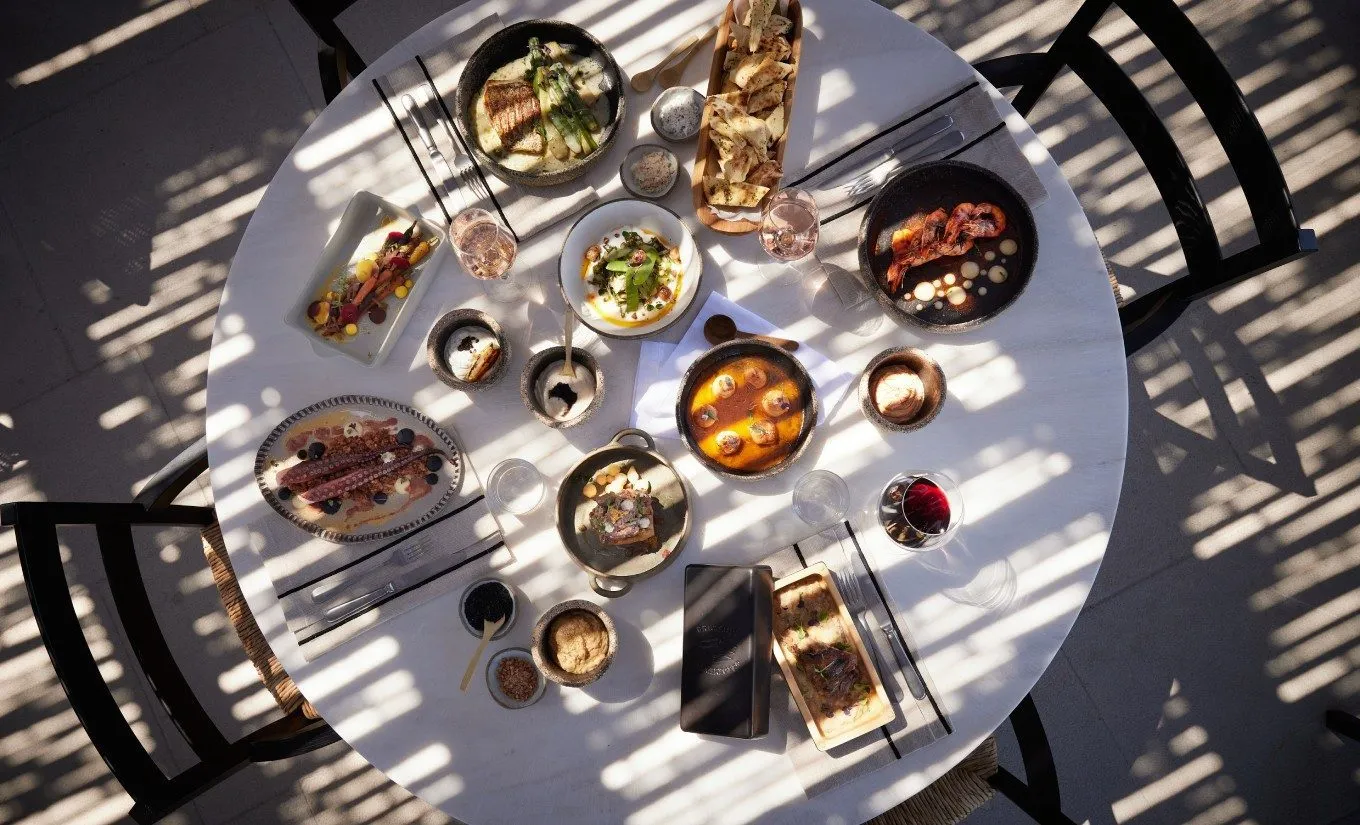
Pere Ubu, the property’s restaurant, reflects the quieter elegance of the experience. Meals unfold gradually here, shaped by Mediterranean seasonality, long conversations and a natural sense of ease. Nothing feels overly orchestrated. Luxury reveals itself through confidence rather than complexity.
Elsewhere, Kuveda brings a different energy. Inspired by the spirit of the traditional Greek kafenio, Kuveda reinterprets familiar rituals through a more contemporary lens. Guests gather over shared plates, cocktails and music as sunset fades into evening. Conversations move between tables. Familiar faces emerge naturally after only a few days on the island.
It captures something increasingly rare within modern luxury hospitality: genuine social warmth without performance.
At Kalesma, wellness exists less as a separate offering and more as part of the overall philosophy of staying.
Morning yoga overlooking the sea. Long walks through sunlit pathways. Quiet afternoons uninterrupted by programming. Treatments shaped around restoration rather than transformation.
Even silence itself becomes part of the experience. For many travelers navigating the speed and noise of contemporary life, this slower rhythm has become its own form of luxury.
Not withdrawal from the world. But reconnection to it.
The renewed fascination surrounding Mykonos right now is understandable.
The island occupies a rare space within global travel culture. It remains instantly recognizable while still carrying the ability to surprise people emotionally. It is both iconic and deeply personal.
But perhaps what travelers are increasingly seeking from Mykonos Summer 2026 is not simply energy.
It is contrast.
A version of the island that still allows for stillness.
For quieter mornings. Longer dinners. Architecture connected to land. Hospitality shaped around emotion rather than performance.
Places where the memory of how something felt lasts longer than the image itself.
That is the space Kalesma quietly inhabits.
Not attempting to compete with Mykonos.
But offering a different way of belonging to it.
Long after leaving Kalesma, what often remains are not singular grand moments, but fragments.
Morning light moving slowly across stone. The outline of Delos at sunset.
Bare feet against warm terraces after midnight. A lunch that became evening without anyone noticing.
The feeling, increasingly rare in modern travel, of having nowhere else to be. And perhaps that is why places like this matter more now than ever. Because even as Mykonos returns once again to global attention, the island still holds quieter stories within it. You simply have to know where to look.
Discover Kalesma Mykonos and experience a slower rhythm of island living.
Where should I stay in Mykonos for a quieter luxury experience?
Travelers looking for a slower and more design-led experience in Mykonos often choose boutique properties away from the island’s busiest party areas. Kalesma offers a more peaceful atmosphere focused on contemporary Cycladic living and meaningful hospitality.
Does Kalesma offer sunset views?
Yes. Many suites, villas and shared spaces overlook the Aegean Sea toward Delos, creating some of the island’s most distinctive sunset views.
What makes Kalesma different from other luxury hotels in Mykonos?
Kalesma was designed as a contemporary Cycladic village rather than a traditional resort. Its slower rhythm, architecture and understated approach to luxury create a more emotionally restorative experience.
Does Kalesma have private pools?
Many of Kalesma rooms, suites and villas feature private pools overlooking the Aegean Sea and Delos.
What dining experiences are available at Kalesma?
Guests can enjoy Mediterranean dining at Pere Ubu and a more social, kafenio-inspired atmosphere at Kuveda.
Is Kalesma suitable for wellness-focused travel?
Yes. Yoga, slower daily rhythms, restorative treatments and open-air living all contribute to Kalesma wellness philosophy.